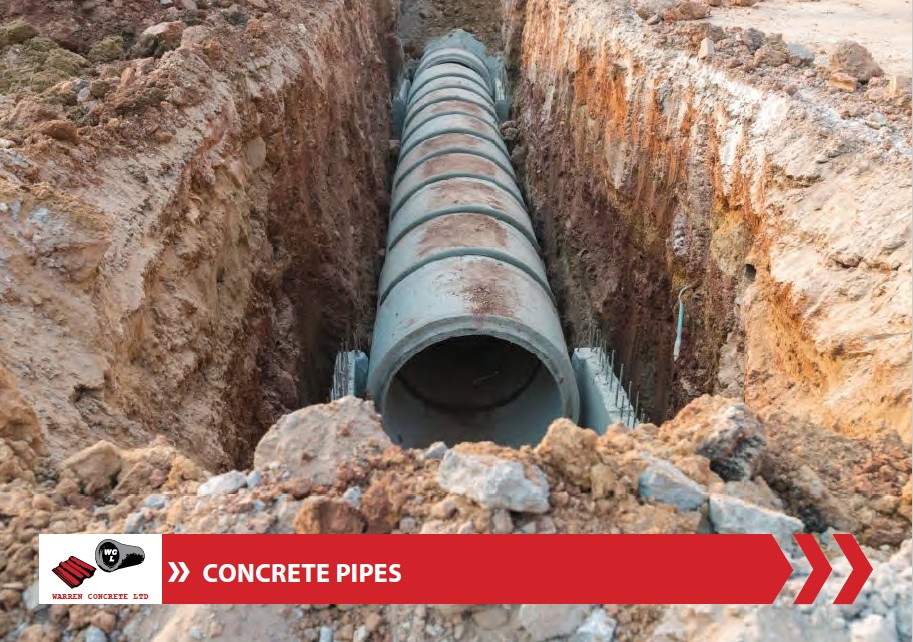
Concrete pipes are essential components in modern infrastructure projects, used for the transportation of water, sewage, and stormwater. Made from reinforced or non-reinforced concrete, these pipes are highly durable and resistant to corrosion, making them ideal for long-term use in various environmental conditions. Concrete pipes are manufactured in different diameters and lengths to accommodate diverse applications, from large-scale drainage systems to smaller, localized water management needs. Their strength allows them to withstand heavy loads and high pressure, making them suitable for underground installation under roads and highways. Additionally, concrete pipes are known for their minimal maintenance requirements and excellent sustainability, as they can be produced using environmentally friendly materials.
9 GOOD REASONS WHY YOU SHOULD USE PRECAST CONCRETE PIPES
1. SUSTAINABILITY
Precast concrete pipes outperform other pipeline
solutions in a number of the environmental impact
categories, such as human toxicity levels and
chemical or hazardous waste generated. The CO2
emissions from concrete production are relatively
small compared to other building materials. Some
95-99% of ingredients used in the production of
concrete pipes are sourced locally, so a considerable
positive impact on the carbon footprint and fuel
consumption associated with transporting these
materials can be achieved.
2. STRENGTH
Precast concrete pipe is more durable than any
other kind of pipe. Hence, it can carry more load
at any given time and gains strength over time.
It cannot be weakened by heat, moisture, mold or
pests, nor will it rust. Precast concrete pipe will not
rust, burn, tear, buckle or deflect, have the ability
to resist chemical attacks and is immune to most
environmental elements. A general lack of pipe
stiffness is the biggest contributor to deflection and
deformation problems in plastic pipes.
3. QUALITY
Since precast concrete pipes are produced in highly
controlled plant environments under rigid production
standards and testing specifications, they achieve
consistent high quality levels of performance.
4. FIRE RESISTANCE
Being naturally fire-resistant, concrete forms a
highly effective barrier to fire spread and it does not
emit any toxic fumes when affected by fire. It will not
produce smoke or drip molten particles. Therefore,
in the majority of applications, concrete can be
described as virtually ‘fireproof’. Due to its inbuilt fire
resistant properties, concrete not only maintains an
airtight construction that stops smoke spreading,
but also has the ability to keep its strength during
a fire.
5. WHOLE LIFE VALUE
Due to its amazing structural properties and
functional benefits, precast concrete pipes tend to
attract lower insurance premiums than those built
from other construction materials. The natural
strength of precast concrete pipes enables
recycled aggregate to be used as a bedding
material, significantly reducing installation costs
and the elimination of waste disposal costs. Plastic
pipe products may have lower initial costs, but they
are not as cost-effective as concrete pipe. Over the
long term, plastic pipe has a shorter service life, and
requires premium bedding and backfill. Installation
procedures have to be precise for the bedding
and backfill to take on the required structural
characteristics. During and after installation,
inspection of plastic pipe systems is critical to
performance, and mandrel or laser/video testing is
mandatory in many jurisdictions. In general, the true
cost (installation, maintenance and replacement)
of plastic pipe can be twice that of concrete
based on a 50-year or greater service life. Precast
concrete pipe is the strongest drainage product
available, the most hydraulically efficient, and has
great current and future value as an infrastructure
asset.
6. BEDDING PERFORMANCE
The superior strength of concrete pipes enables
recycled aggregate to be used as a bedding material,
thus reducing costs and environmental impact
during installation. Since a full trench depth of
granular material can actually be more expensive
than the pipe, significant pipe bedding savings can
be achieved when using a concrete pipe instead.
7. HYDRAULIC EFFICIENCY
The rigidity and mass of precast concrete pipes
(within the pipe & pipe joints) allows it to retain its
shape over its long service life, preserving structural
integrity & hydraulic efficiency, by minimizing the
resistance to water-flow that often occurs when the
shape or integrity of a plastic pipe is compromised
through deformation.
8. INSTALLATION
The primary purpose of a conduit is to move a
certain amount of storm water from one point to
another. A precast concrete conduit, in conjunction
with the surrounding soil, provides the structure
the installation must provide. Concrete pipe far
outperforms plastic pipes. Concrete’s rigidity and
mass allow for easy and secure placement in the
ditch, without disrupting line/grade. Precast
concrete pipe joints are easily assembled, which
help minimize the time needs for installation.
Precast concrete pipe is a rigid pipe system that
is over 85% dependent on the pipe strength & only
15% dependent on the strength derived from the
soil envelope, thus installation is made easy. Unlike
plastic pipe, where up to 95% of the structure must
be painstakingly designed & installed in the field.
The installation of plastic or metal pipes can take
longer than precast concrete pipe. That’s because
the structural & hydraulic integrity of plastic pipes
rely heavily on how well you prep the surrounding soil
at installation, rather than on their own inherent brute
strength. Plastic pipe installation requires carefully
selected backfill material, high compaction of the
backfill, on-site inspection and post-installation laser
testing which all increase the overall time and cost of
installation. The longer lengths of pipe require close
control of bedding material, grade and compaction
during installation, or high & low spots or deflection
may occur.
9. CHEMICAL RESISTANCE
Precast concrete pipes and manholes are resistant
to sulphate & chemical attack. Concrete pipeline
products with higher design chemical classes need
special instructions and sulphur resistant cement
which are capable of withstanding ttack from
aggressive ground environments ttack from
aggressive ground environments.
We use cookies to ensure that we give you the best experience on our website. If you continue to use this site we will assume that you are happy with it.